♥ Saturday, January 22, 2011
Week 1: History of Internet
It all started with the launch of Sputnik I by the Soviet Union that changed the history of political, military, technological and scientific developments.

Being the geek I am, I'm proud to say that this satellite was launched on my birth date, 4 October 1957. The world's first artificial satellite was about the size of a volleyball, weighed 83.6 kg. and it took about 98 minutes to orbit the Earth on its elliptical path. Sputnik caught the world's attention and the American public off-guard.
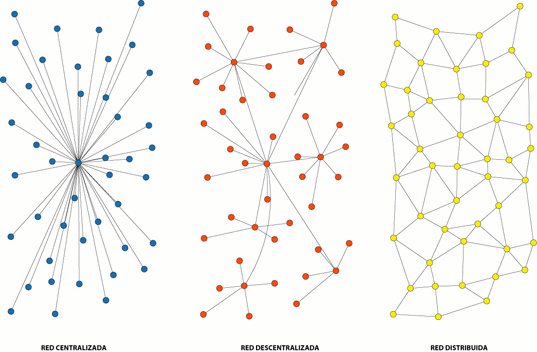
In response to the launch of Sputnik, the Advanced Research Project Agency (ARPA) was created by the Americans to prevent technological surprise. However it was not until later, in 1964, RAND Corporation published reports on how network were able to divide and segment information and messages independently.

In 1967, this dude (above) named Donald Davies coined this processing of dividing messages as 'packet-switching'. 2 years later, APRANET (Advanced Research Projects Agency Network) used the first mode of packet-switching between SRI International, a non-profit research institute that conducts contract R&D for government agencies and other businesses, and UCLA. The physical network was constructed to better understand how information are being shared.
In 1972, Ray Tomlinson created the first Email program and introduced the "@" symbol. By 1973, 75% of all network traffic consisted of E-mailing. This spike in the increase of using email was because computers were able to communicate with each other. And in 1974, the named "Internet" was born.
Fast forward to the 80's, domain name services was implemented so that it made it easier for people to identify and locate computers which are linked to the internet. For example, .com, .gov and .ca.
In 1990, the term "World Wide Web" was coined by Tim Berners-Lee. 3 years later, Mosiac was released, becoming the first commercial software which allowed graphical access to content displayed on the internet and became the first internet browser (IE). In 1996, a reported of 45 million people were using the internet and by 2007, the number grew to approximately 1.3 billion.
The internet had come a long way since the late 50s and the uses of it had changed over time as well. Initially, only government officials and those who were of proficient jobs have the access. But now, everyday people are able to purchase a computer due to better standard of living.
Be it a laptop, a desktop or an iPad, they are given the freedom to use the internet anyway they can. For leisure and communication, in turn, the internet had come up with various social network to cater to the users' need of communicating with others no matter where they are. Internet had become more mobile and it serves as a convenience to everyone.
Sorry if my entry is a tad dry. Will come up with something way more interesting next time. :D
Blogged @ 2:08 AM
